If you’ve ever searched for health information online, you’ve probably wondered whether you can trust what you’re reading.
Unfortunately, that’s becoming a harder question to answer. AI-generated articles, outdated advice, sensationalist headlines and poorly researched content are everywhere. While some inaccuracies are merely frustrating, others can have genuine consequences for people’s health.
That’s exactly why the Patient Information Forum (PIF) created the PIF TICK: an independent quality standard that helps people identify health information they can trust. It exists to raise the standard of health communication and give readers confidence that what they’re reading has been produced using robust, evidence-based processes.
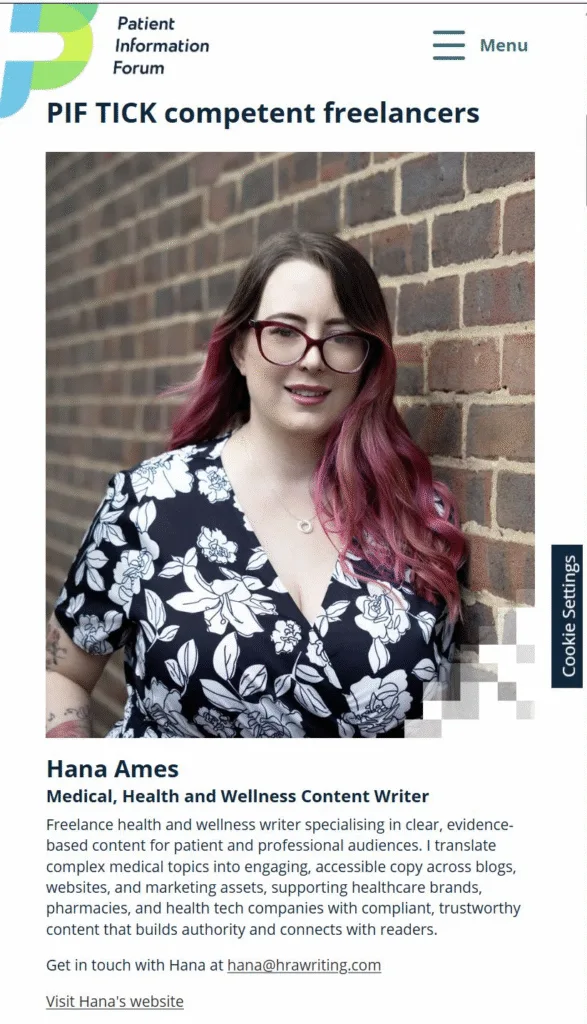
As a freelance health writer, I can’t receive full organisational PIF TICK certification because I don’t control how clients publish or maintain content after I’ve delivered it. However, I can demonstrate that I understand and work to those same standards through the PIF TICK Competent scheme for freelancers.
I’m delighted to say that’s exactly what I’ve done.
What is the PIF TICK?
The PIF TICK is the UK’s only independently assessed quality mark for health information. Organisations awarded the PIF TICK have demonstrated that their health information is created using rigorous processes designed to ensure it is accurate, accessible and genuinely useful to patients and the public.
To achieve certification, organisations undergo an independent annual assessment against ten key criteria, covering everything from evidence gathering and accessibility to user involvement and ongoing quality improvement.
The principles include:
- Using reliable, up-to-date evidence
- Writing in clear, accessible language
- Meeting the needs of the intended audience
- Considering health literacy and accessibility
- Following consistent editorial processes
- Being transparent about sources and conflicts of interest
- Measuring the effectiveness of health information
- Keeping information reviewed and up to date
In other words, it’s about far more than simply “getting the facts right.”
So what does PIF TICK Competent mean?
Freelancers face a slightly different challenge.
Even if we write outstanding health information, we usually aren’t responsible for the final publication. Clients decide whether articles are reviewed, when they’re updated, how they’re presented and what happens after delivery.
Because of that, freelancers can’t usually become fully PIF TICK certified.

Instead, the Patient Information Forum created PIF TICK Competent, allowing freelance writers and editors to demonstrate that they understand the PIF TICK framework and know how to apply its principles throughout the writing process.
For me, it demonstrates a commitment to producing health content that doesn’t just rank well or sound authoritative – it follows recognised best practice from the moment I start researching until I hand over the finished copy.
Why should clients care?
Health content isn’t like writing about holidays or kitchen appliances.
People often read health information when they’re worried, vulnerable or trying to make important decisions. Poor-quality content can increase anxiety, spread misinformation or leave readers feeling more confused than when they started.
Whether you’re:
- a healthcare provider
- a pharmaceutical company
- a digital health business
- an online pharmacy
- a charity
- or a health publication
…the quality of your content reflects directly on your organisation.
Working with someone who understands recognised health information standards helps reduce risk while improving the overall quality of your content.

It means thinking beyond keywords and readability scores to ask questions like:
- Is this evidence current?
- Have we explained uncertainty where appropriate?
- Could someone without medical knowledge understand this?
- Have we unintentionally excluded parts of our audience?
- Are we helping people make informed decisions rather than simply generating traffic?
Those are the kinds of questions I ask on every project.
It aligns with how I’ve always worked
One of the reasons I was keen to complete the PIF TICK Competent scheme is that it formalises many of the principles I’ve followed throughout my career.
When I write health content, I already prioritise:
- evidence from trusted sources
- clear, jargon-free language
- balanced, accurate messaging
- empathy for the reader
- accessibility
- transparency about evidence
- understanding the audience before writing a single word
The competency scheme reinforced those practices while helping me build an even stronger understanding of recognised standards for health information production.
Trust is becoming your biggest competitive advantage
With AI making it easier than ever to generate health content in seconds, quality has become more valuable – not less.
Anyone can produce an article that looks convincing.
Far fewer people know how to produce health information that is accurate, responsible, evidence-based and genuinely helpful.
That’s increasingly what organisations are looking for, and it’s exactly why standards like the PIF TICK matter.
Final thoughts
Becoming PIF TICK Competent isn’t just another badge to add to my website.
It’s an independent recognition that I understand the principles behind producing trustworthy health information and that I’m committed to applying them in every project I take on.
If you’re investing in health content, you deserve more than just words to fill a webpage. You deserve content that’s accurate, accessible, evidence-based and written with the people reading it firmly in mind.
That’s exactly the standard I aim to deliver.
Ready to create health content people can trust?
If you need evidence-based content that puts accuracy first, I’d love to help. Email me to discuss your project, or book a free discovery call to see how we could work together.
If you’ve found this useful, feel free to fuel my caffeine addiction at Ko-fi